5 trades show how to trade meme coins with a $10 portfolio
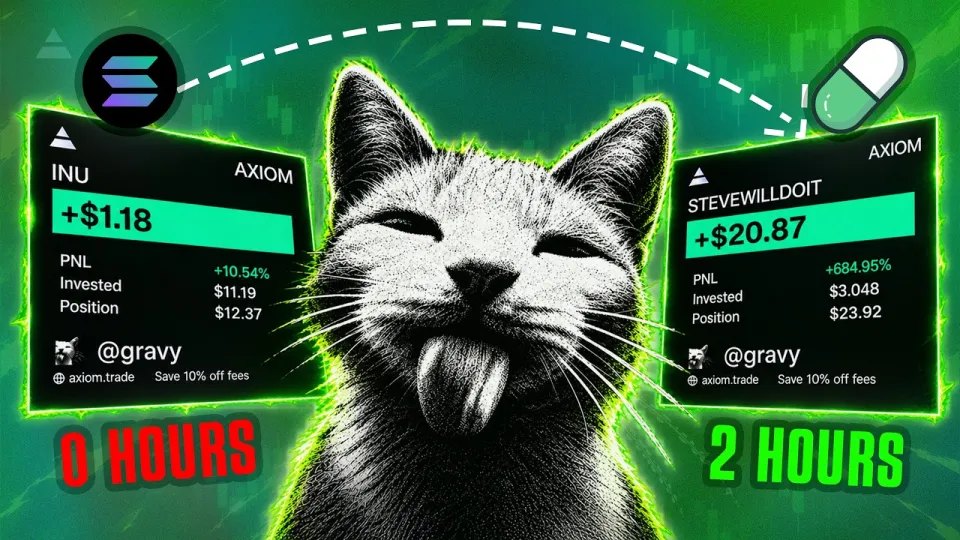
Video: I Tried Trading Memecoins with Just $10
You can order the same kind of articles for your own video to boost it on YouTube and Google. Just message the Telegram bot @sat_sit_bot. Articles with your video embedded are written and posted by the bot itself — on popular topical sites (no ads). Try it free: 50 articles on us.
Meme coin trading with a $10 portfolio is possible, but only if every buy stays tiny and every exit is planned before entry. A five-trade test on Solana, each position kept under 0.05 SOL, shows that fees and slippage decide the outcome long before conviction does. The trades were placed through Axiom, the trading terminal used in the test, which offers referral cashback and reduced fees.
The experiment, published by the channel gravy, walks through each buy and sell rather than just the result: why the coin was picked, why it was sold, and which one was mishandled. That structure matters more than any single ticker, because a small balance leaves almost no room for a slow exit.
Why a $10 meme coin portfolio is a fee problem first
The real obstacle to trading meme coins with a small balance is cost per round trip, not the size of the position. On Solana, every trade carries a network fee, a swap fee and slippage, and those fixed costs are charged in roughly the same amount whether the order is $10 or $1,000.
That produces a simple rule set for low-balance trading:
- Keep each buy below a hard ceiling, in this case 0.05 SOL, so a total loss never removes the whole stack.
- Prefer coins with deep enough liquidity that a small market order does not move the price against you.
- Count the round trip before entering: two swap fees plus slippage plus priority fees is the minimum loss you accept on a flat trade.
- Treat the remaining balance as ammunition, not as a position. A $10 portfolio that goes all-in on one coin has no second attempt.
The upside of a small size is psychological: exits are easier to take because the amount at risk is trivial. The downside is arithmetic: a 30% gain on a $2 position is $0.60, which barely covers the cost of getting in and out.
Trade 1 on STEVEWILLDOIT and the X Money coin meta
The first trade was STEVEWILLDOIT, a coin built on a well-known internet meme, bought as the X Money narrative was running. The reasoning behind that meta was the e/acc and Cream storyline, a cluster of accounts and ideas that pushed attention toward payments on X and the tokens attached to it.
What makes this kind of trade work is timing relative to the narrative, not the quality of the joke. Meme coins have no cash flow, so price is a function of attention: who is posting, how many people see it, and whether the story is still spreading. By the time a narrative is widely understood, the cheap entries are gone.
For a $10 portfolio the practical lesson is to size the first trade as a probe. If the coin moves, the position can be added to; if it stalls, the loss is a few cents of fees rather than a meaningful share of the stack.
Trade 2 on NPC and reading a saturated narrative
NPC was the second position, a token riding the broad "NPC" internet meme rather than a single event. Coins like this behave differently from news-driven ones: they rise on community momentum and fade when the joke stops producing new posts.
A saturated narrative is the most common way small traders lose money. The chart looks strong, the timeline is full of the ticker, and the buy happens exactly when the marginal buyer is running out. The viewer question that comes up most often is precisely this: finding a coin with a good story and still losing because the dip keeps dipping.
The workable answer is to define the exit before entry. On a small balance, a fixed target and a fixed stop, both calculated after fees, remove the decision from the moment of maximum emotion.
Trade 3 on MET and why infrastructure tickers behave differently
MET, the Meteora ticker, was the third trade and stands apart from the pure meme plays. Meteora is a liquidity infrastructure project on Solana, so a token carrying that name attracts a different audience: traders who recognise the brand rather than people chasing a joke.
That changes the risk profile. Brand-adjacent tickers can hold attention longer because the underlying name is searched and discussed anyway, but they also invite confusion between the token being traded and the actual product. A trader with $10 should check who is behind a ticker and whether the name is licensed, borrowed or unrelated before assuming the brand does any work.
Trade 4 on PUMPY the Trader and launchpad momentum
PUMPY the Trader was the fourth position, a launchpad-style coin tied to the Pump.fun ecosystem where new tokens are created continuously and cheaply. Launchpad coins are the highest-variance category in meme coin trading: supply is effectively unlimited, so attention is the only scarce resource.
Two mechanics matter for a small account:
- Graduation and liquidity: a coin that has not attracted enough liquidity will punish any exit, even a tiny one.
- Velocity: launchpad narratives rotate in hours, so a position held overnight is a different trade from one held for twenty minutes.
This is the trade the creator describes as badly fumbled, which is the most useful part of the experiment. Execution errors, not coin selection, are what turn a small winner into a loss.
Trade 5 on UNTXD and closing the experiment
UNTXD was the fifth and final trade, closing out a run in which no single buy exceeded 0.05 SOL. Five positions is enough to see a pattern: the trades that worked were entered early in a narrative and exited on a plan, and the one that failed was mismanaged rather than mispicked.
The video ends by asking viewers whether the next step should be live trading from a doxxed wallet starting at 0.1 SOL or 1 SOL. That question is the honest summary of small-balance meme coin trading: the method scales, but the fees do not shrink with the account.
What viewers keep asking about meme coin trading
The recurring doubts in the comments are about consistency and information overload, not about which terminal to use. Finding coins with good narratives feels overwhelming when it means reading every post and remembering who carries influence in each community.
The practical response is to narrow the funnel rather than widen it. Follow a small set of accounts that reliably surface narratives early, keep a written list of the metas currently running, and accept that missing most of them is normal. A trader with $10 does not need to catch every rotation; two clean round trips beat ten forced ones.
A second recurring theme is the missing total profit and loss figure at the end of the video, which is a fair criticism of any trade log. Anyone repeating the experiment should record entry, exit, fees and slippage for every trade, because the gross number flatters a small account and the net number is the only one that matters.
Useful links
- Axiom trading terminal — the platform used for the trades, with referral cashback and reduced fees.
- The Trenches Discord — community around the channel.
- Discord with free Axiom imports and trade signals — not financial advice.
- gravy on X — trade posts and updates.
- Bitbase leveraged trading — 20% reduction on futures fees.
The takeaway from five small meme coin trades
The experiment answers the question directly: meme coins can be traded with $10, but the constraint is discipline and cost control rather than capital. Keeping every buy under 0.05 SOL preserves the ability to take several attempts, and the trades that worked were the ones with a narrative entered early and an exit defined in advance. The fumbled trade is the reminder that execution, not coin picking, is where small accounts bleed. The full walkthrough comes from the channel gravy, and the terminal used for the trades is available through Axiom.
Key takeaways
- Five real trades on Solana, each buy kept under 0.05 SOL, roughly $10 of starting capital.
- Tickers covered: STEVEWILLDOIT, NPC, MET (Meteora), PUMPY the Trader and UNTXD.
- The X Money coin meta is tied to the e/acc and Cream narrative cycle.
- Fees and slippage are the main constraint on a $10 portfolio, not the size of the position.
- The video ends by asking viewers whether to live trade a doxxed wallet from 0.1 SOL or 1 SOL.
Source: I Tried Trading Memecoins with Just $10 · Markdown version
Questions & answers
Can you actually trade meme coins with only $10?
Yes, but the position size has to stay small enough to survive several attempts. In the test, every buy was kept under 0.05 SOL, so fees and slippage were a fixed cost against a tiny position. The method works as practice and as a way to learn execution, not as a route to meaningful income.
How much do fees and slippage eat on a small meme coin trade?
Every round trip carries network fees, swap fees, priority fees and slippage, and those costs are roughly the same on a $10 order as on a $1,000 order. On a small balance they can consume a large share of any modest gain, which is why the round-trip cost should be calculated before entering.
Why do I lose money on coins with good narratives?
Usually because the entry happens after the narrative is already widely known, when the marginal buyer is running out. A coin with a strong story can still fall if the attention that drives it has peaked. Defining a target and a stop before entry, calculated after fees, removes the decision from the most emotional moment.
What is the X Money coin meta mentioned in the test?
It is a narrative cluster around payments on X, pushed by the e/acc and Cream storyline and the accounts associated with it. Tokens attached to that story ran because attention moved toward it quickly. Like any meta, the cheap entries existed only while the story was still spreading.